
Two game prototypes with simulation cores and bot tests
Outside work I build games with coding agents. The game rules sit in a core without any engine code, so bots can play thousands of rounds and tests can check every rule. Neither game is released.
- Role
- Design, architecture, checks
- Built with
- Godot 4 and C#, TypeScript and Electron, coding agents
- Status
- Playable prototypes, unreleased
MOSSHEART
Co-op tower defense, Godot 4 with a C# core
One to four players defend an old tree with a glowing heart for 40 nights against waves of procedurally bred creatures.
- Port with golden values
- Ported from a running web version to C#: 944 golden checks and 4,477 checkpoints of a replay, compared by checksum every second of game time.
- Bit-identical random numbers
- The random number generator matches the JavaScript original over 100,000 draws. The only real porting defect: .NET’s Hypot differs from V8’s Math.hypot in the last bit; rebuilt, now 300,000 of 300,000 identical.
- Bot balance probe
- A bot plays 40 nights in 4 seconds. It found no scarcity and 147 towers, which led to a tower limit.
- Network load
- Snapshots cut from 33 kB to 0.57 Mbit/s, a factor of 42, with a build image, packed arrays, 15 Hz and zstd.
- Honest test coverage
- A contract of 30 checks measured against 84 blind defects: 23 percent caught; core 6 of 6, Godot runtime 0 of 35.
KERBHOLZ
Deck-building roguelike, TypeScript and Electron
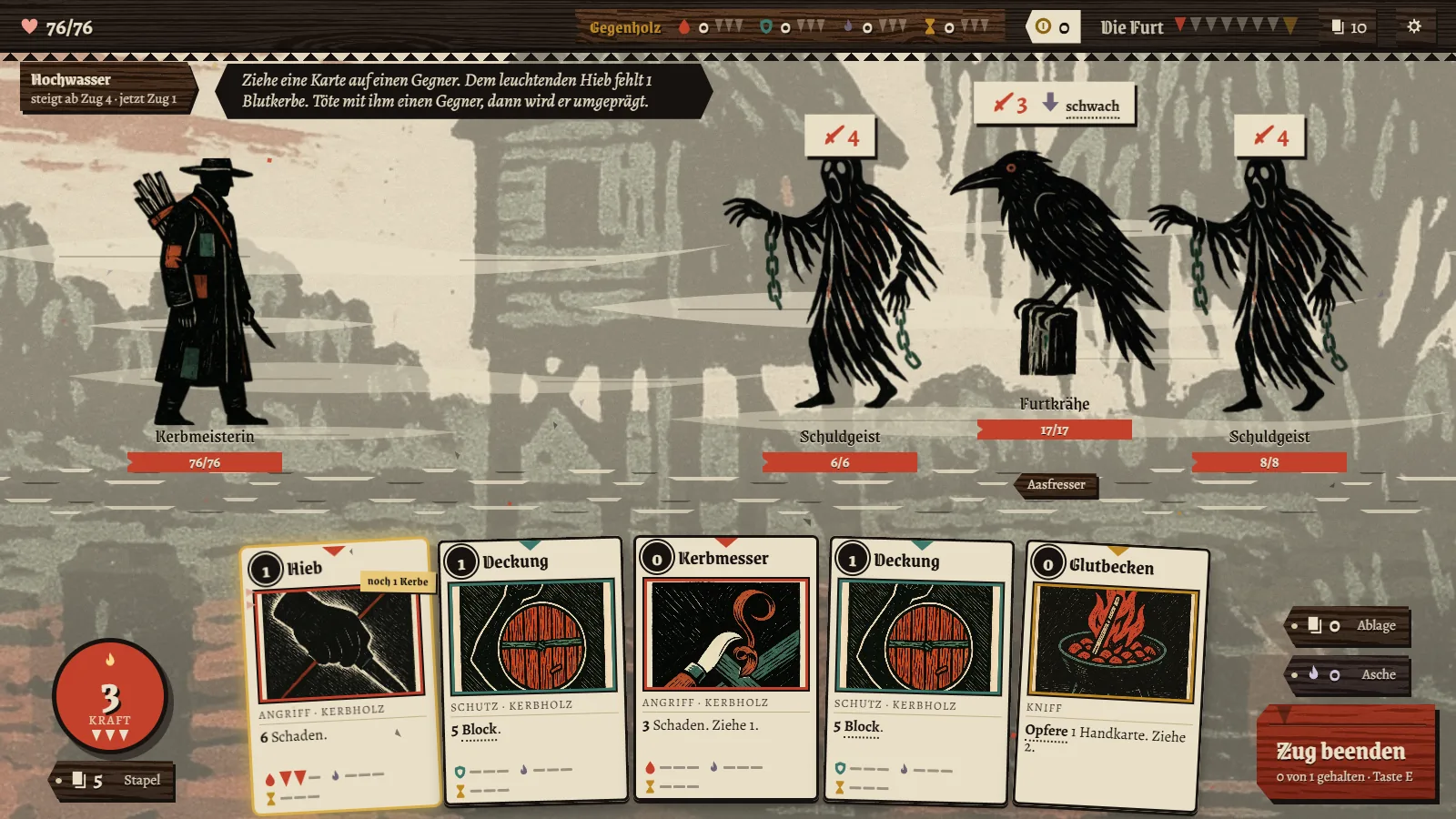
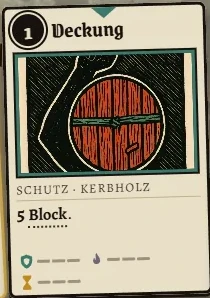
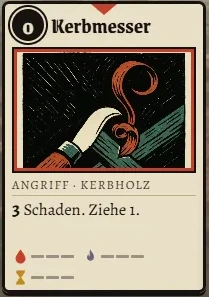

You fight through villages with a deck of cards. Each starting card remembers whether it killed, protected, was sacrificed or waited, and reshapes into another card.
- Rules as pure functions
- The core has no interface code; randomness only through a seeded generator, so every run can be reproduced from its seed.
- Sabotage battery
- Mutations in the core must turn the tests red: 358 of 358 caught.
- Bot measurements
- A test player and balance gates with an evaluation fixed in advance. One finding: taking loot cards made decks worse, because they took up hand slots.
- Quality gate per image
- 73 files with three separate reviews each before an image counts as finished.